
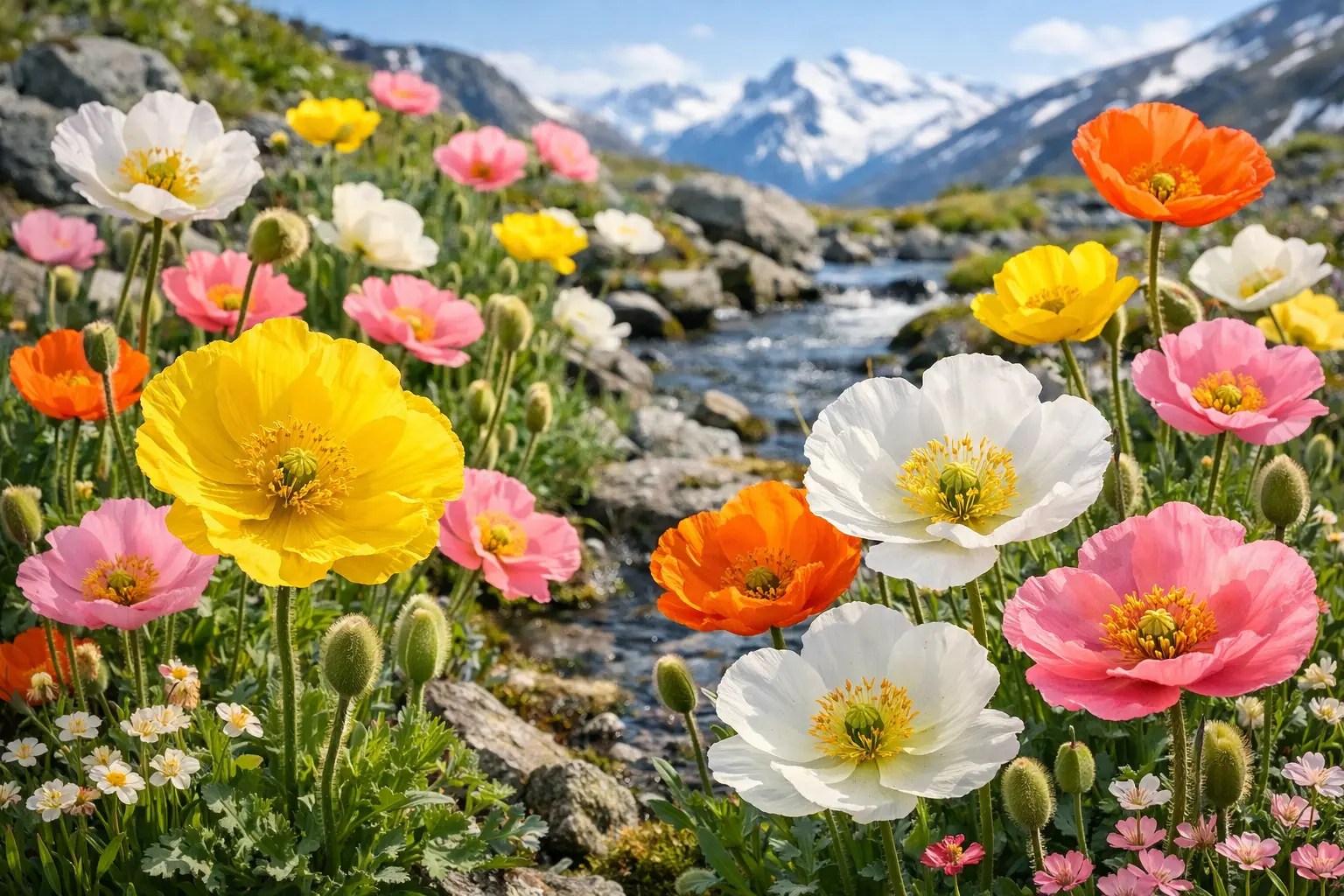
Arctic Poppies: A Cold-Hardy Perennial for Every Garden
Introduction
Arctic poppies are beautiful, cold-hardy perennial flowers that are easy to grow and adaptable to most regions of the United States. They are also known as Iceland poppies and are a popular choice for gardens of all sizes.
Description
Arctic poppies are herbaceous, low-growing plants that produce numerous single papery blooms in a wide range of colors, including yellow, red, white, and orange. They are cup-shaped and follow the sun to absorb more solar energy in low-light regions. The blooms have crinkly tissue paper petals and are up to 3 inches (7.5 cm) across.
Arctic poppies are native to arctic and sub-arctic climates, but they are also tolerant of temperate zones, provided there is not an excess of humidity. They are considered alpine plants and are well-suited to rocky areas and cottage gardens.
Growing Conditions
Arctic poppies are easy to grow from seed. They prefer full sun and well-drained soil that is amended with plenty of organic matter. They are drought-tolerant and can survive with minimal watering, but they will bloom more profusely if they receive regular moisture.
Planting
Arctic poppies can be sown directly in the garden in spring or early summer. They are difficult to transplant, so it is best to plant them where they will permanently grow. Space the seeds about 6 inches apart and cover them with a thin layer of soil. Keep the soil moist until the seeds germinate.
Care
Arctic poppies are relatively low-maintenance plants. They do not require a lot of fertilizer, but they will benefit from a balanced 20-20-20 fertilizer diluted in the irrigation water. Deadheading spent blooms will encourage new buds to develop.
Arctic poppies are resistant to deer and attractive to butterflies. They are also tolerant of poor soil conditions and can even grow in rocky areas.
Propagation
Arctic poppies can be propagated by seed or by division. Division is best done in spring or fall. To divide an Arctic poppy, dig up the plant and carefully separate the roots into individual plants. Replant the divisions in well-drained soil and water them deeply.
Uses
Arctic poppies are a versatile plant that can be used in a variety of garden settings. They are a popular choice for beds and borders, containers, rocky areas, and cottage gardens. The cheery blooms add a splash of color to any garden and are a favorite of butterflies.
Long-Tail Keyword Phrases:
- How to grow Arctic poppies from seed
- Best way to grow Arctic poppies in containers
- Tips for growing Arctic poppies in a cottage garden
- How to attract butterflies with Arctic poppies
- How to keep deer away from Arctic poppies
- How long do Arctic poppies bloom?
- How to propagate Arctic poppies from seed
- Is an Arctic poppy an alpine plant?
- Are Arctic poppies drought-tolerant?
By following these tips, you can enjoy beautiful Arctic poppies in your garden for many years to come.
