
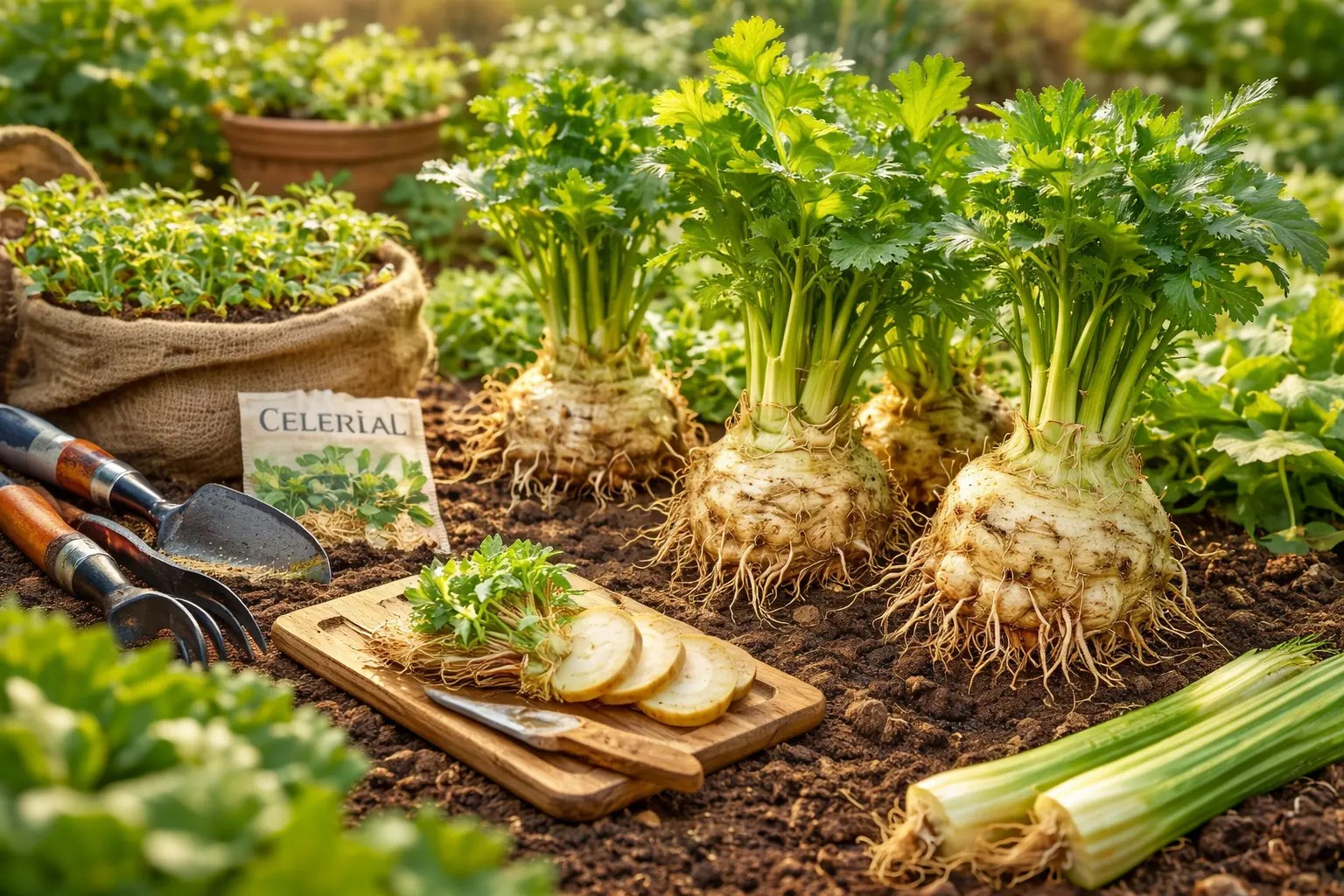
Celeriac: A Versatile Root Vegetable
Celeriac, also known as celery root, is a unique and flavorful root vegetable that belongs to the same family as celery, carrots, parsley, and parsnips. It has a celery-like aroma and flavor, but with a slightly earthier and sweeter taste when cooked. Celeriac can be eaten raw, roasted, baked, or mashed, and it is a popular ingredient in soups, stews, and salads.
Growing Celeriac
Celeriac prefers mild temperatures, full sun to light shade, and moisture-retentive, rich soil. It can be grown from seed or by transplanting seedlings.
From Seed:
- Start seeds indoors 4-6 weeks before the last frost.
- Sow seeds 1/4 inch deep and 10-12 inches apart.
- Keep the soil moist and at a temperature of at least 65°F (18°C).
- Seedlings will emerge in 21 days or longer.
Transplanting:
- Transplant seedlings when they are 2-2 1/2 inches tall.
- Space plants 12-18 inches apart.
- Water deeply after transplanting.
Care
- Celeriac has shallow roots that need to be kept moist at all times. Mulch around the plants to retain moisture.
- Fertilize monthly with an all-purpose fertilizer.
- To encourage larger root formation, snip side roots and hill soil up over the swollen bulb.
Harvesting
- Celeriac is ready to harvest in 100-150 days.
- Cut stems close to the root and lift the roots out of the ground using a garden fork.
- Celeriac can be stored in a cool, dark place for several months.
Varieties
There are many different varieties of celeriac, each with its own unique characteristics. Some popular varieties include:
- ‘Alabaster’: True celery flavor
- ‘Brilliant’: Smooth, less fibrous root
- ‘Giant Prague’: Large white roots, strong flavor
- ‘Marble Ball’: Stores well, strong celery flavor
- ‘Mars’: Large, uniform-sized roots
- ‘Monarch’: Smooth exterior, easy to grow and peel
- ‘Prinz’: Smaller roots, smooth white skin
- ‘Yara’: Slow to bolt
Nutritional Value
Celeriac is a good source of fiber, potassium, and vitamin C. It is also low in calories and fat.
Health Benefits
Celeriac has several potential health benefits, including:
- Improved digestion: The fiber in celeriac can help to improve digestion and prevent constipation.
- Reduced inflammation: Celeriac contains antioxidants that can help to reduce inflammation throughout the body.
- Lowered cholesterol: The fiber in celeriac can help to lower cholesterol levels.
- Boosted immunity: Celeriac is a good source of vitamin C, which is essential for a healthy immune system.
Troubleshooting
- Stunted roots: Irregular irrigation can result in stunted roots.
- Leaf blight: Soak seeds in a formaldehyde solution before planting to prevent blight.
- Aphids: Manage aphids to prevent celery mosaic virus.
- Slugs and snails: Handpick or use slug bait.
- Leaf miners: Pick off yellowing leaves.
- Cutworms: Use plant collars or diatomaceous earth to combat cutworms.
Conclusion
Celeriac is a versatile and nutritious root vegetable that is easy to grow. With its unique flavor and numerous health benefits, celeriac is a valuable addition to any garden.
